Hair transplant FAQs.
Clear answers for you.
Scalp, beard and eyebrow transplantation in the Dominican Republic: understand the options, aftercare and the next step for your situation.
Educational content from Majestuoso Clinic
41 questions available
No matching combination. Try another word or explore the topics.
Educational information to prepare for consultation. It does not replace medical assessment or the personal instructions for your procedure.
Hair loss and candidacy
What is a hair transplant and what can it improve?
A hair transplant moves your own follicular units from a donor area to areas affected by hair loss. It may help restore a receding hairline, temples or crown when the diagnosis and donor supply support surgery.
At Majestuoso Clinic, the starting point is your history and goals. Surgery does not create new follicles or automatically restore teenage density. Planning considers available donor hair, texture, future hair loss and your expectations so that the proposed approach is realistic over time.
How do I know if I am a candidate for a hair transplant in the Dominican Republic?
Candidacy requires a medical assessment of the cause and pattern of hair loss, scalp condition, donor area, health history and expectations. A receding hairline or low density alone does not establish that surgery is the right next step.
Photographs and the website form help prepare initial guidance but do not replace the examination needed to confirm a diagnosis. During a Majestuoso Clinic consultation, explain whether you want to address ongoing shedding, restore a particular area or understand your options before deciding on hair transplantation.
Is all hair loss androgenetic alopecia?
No. Hair loss can have different patterns and causes. Your history, the time course and an examination help distinguish conditions that need different approaches; counting shed hairs or comparing a photograph with an online scale is not enough.
If loss starts suddenly, occurs in patches or comes with scalp discomfort, request medical assessment. Trichology and dermatological evaluation help establish whether to investigate a cause, treat existing hair, monitor changes or consider surgery. Choosing an approach starts with understanding the condition rather than assuming every patient needs a transplant.
Further reading: American Academy of Dermatology · Hair loss diagnosis and treatment ↗Can women have a hair transplant?
Women may be candidates in selected cases after assessing the cause of loss, its distribution and donor-area quality. Receding temples, hairline reconstruction and overall thinning require different assessments.
You can discuss female hair restoration with Majestuoso Clinic without assuming you need surgery. Explain previous treatments, recent changes and usual hairstyles. Any proposal should respect the hairline shape, hair texture and expected progression. Some patients need a different approach first, and a consultation is the place to understand those alternatives and the limits of transplantation.
Techniques and donor area
What do FUE and DHI mean in hair transplantation?
FUE describes the individual removal of follicular units from a donor area using small circular instruments. DHI commonly describes implantation using implanter devices. These terms refer to different stages; a tool’s marketing name alone does not determine the quality of surgery.
When discussing FUE–DHI in Santo Domingo or Santiago, ask how donor and recipient areas will be planned and who will perform each stage. Understanding the clinical plan, graft handling and follow-up is more useful than choosing a procedure solely by its technical label.
Further reading: ISHRS · A guide to hair transplant surgery ↗How do FUE and FUT differ, and do they leave scars?
FUE removes follicular units individually. FUT, or strip surgery, removes a strip of scalp that is then divided into grafts. The harvesting method and resulting scar pattern differ.
FUE does not mean completely scar-free surgery: small dot-like marks may remain. FUT leaves a linear donor scar. Visibility depends on healing, hairstyle and planning. At consultation, discuss previous scarring and your preferred haircut so the clinician can explain the options, their limitations and what is realistic for your donor area.
Are a graft, a follicle and a hair the same thing?
These terms are not interchangeable. A visible hair is the shaft emerging from the skin; a follicle is the structure producing it. A follicular unit may contain more than one hair, while a graft is the tissue transferred during surgery. Consequently, 3,000 hairs does not necessarily mean 3,000 grafts.
When comparing hair transplant proposals in the Dominican Republic, ask what is being counted. Coverage area, distribution and donor conservation also matter. A number alone cannot predict your density or allow a fair comparison between different patients.
Where does donor hair come from, and does it grow back in the donor area?
The donor area is usually at the back and sides of the scalp. Density, hair calibre and stability are assessed before deciding how much can be harvested responsibly. The donor supply must not be treated as unlimited.
An extracted follicle is moved to another location; a new follicle does not regenerate where it was removed. In selected situations, other sources from the same patient may be assessed, but their texture and growth differ from scalp hair. A medical assessment determines whether these options fit the plan.
Hair textures and design
Can coily or Afro-textured hair be considered for a hair transplant?
Coily and Afro-textured hair can be assessed for hair transplantation. Its curvature calls for careful donor evaluation and an adapted harvesting and implantation plan. Texture alone cannot establish candidacy or determine a graft count.
At Majestuoso Clinic, explore coily and curly hair cases and explain whether your priority is the temples, hairline, crown or density. Compare photographs from different angles and follow-up periods. Consultation should relate those examples to your actual hair and donor limitations rather than promise another patient’s outcome.
What matters when planning a transplant for curly or wavy hair?
Curvature, calibre and growth direction influence planning for curly or wavy hair transplantation. Hair-to-skin contrast, the distribution of loss and your preferred style also matter. Different curl and wave patterns cannot be treated as identical.
Hairline and crown restoration require different designs. When viewing before-and-after photographs, consider length, styling, lighting and follow-up time as well as texture. Photo-based guidance helps organise your questions; a medical consultation establishes which proposal is reasonable for your particular situation.
Can straight hair or fine hair be transplanted?
These characteristics can be assessed for transplantation. Straight describes shaft shape, whereas fine describes calibre: hair can be both straight and fine. Both influence graft distribution and the discussion of visual coverage.
Graft count is not the only factor affecting the appearance of density. Coverage area, contrast with the scalp and donor supply also matter. At Majestuoso Clinic, planning for straight, fine, wavy, curly or coily hair starts with individual assessment and goals that reflect the combination of characteristics, rather than applying the same density promise to every texture.
How is the hairline designed, and why does the crown need a different assessment?
Hairline design considers facial proportions, age, temple recession, growth pattern and the possibility of further loss of native hair. An overly low hairline may use donor resources that could later be needed elsewhere.
The crown has its own distribution and whorl, requiring a different plan. A calculation made for the front cannot simply be transferred to the crown. Consultation helps prioritise areas, explain the coverage that can reasonably be sought and agree on a personal design that considers both current appearance and future needs.
Preparing for the procedure
Does the graft calculator tell me exactly how many grafts I need?
The website calculator is educational: it explores the relationship between an area and a selected density. It does not measure donor capacity, examine miniaturisation or determine whether your scalp and hair support surgery. It therefore provides neither a surgical indication nor a quotation.
Use it to prepare questions about your hairline or crown. The final follicular-unit plan depends on assessment, priorities and responsible harvesting. The budget you enter in the form is also your stated budget, not a confirmed procedure price.
What should I disclose before the procedure, and should I stop medication?
Share your medical conditions, allergies, previous procedures and a complete list of medicines, hair-loss products, vitamins and supplements. Preparation should also consider bleeding and healing history and advice from your other treating clinicians.
Do not independently stop anticoagulants, cardiac treatment or other prescribed medication. Any changes must be coordinated with the responsible professionals. General website information cannot replace your individual preoperative plan. Confirm with Majestuoso Clinic how to manage your hair products and which personal instructions you will receive before scheduling surgery.
What happens on the transplant day, and how long does it take?
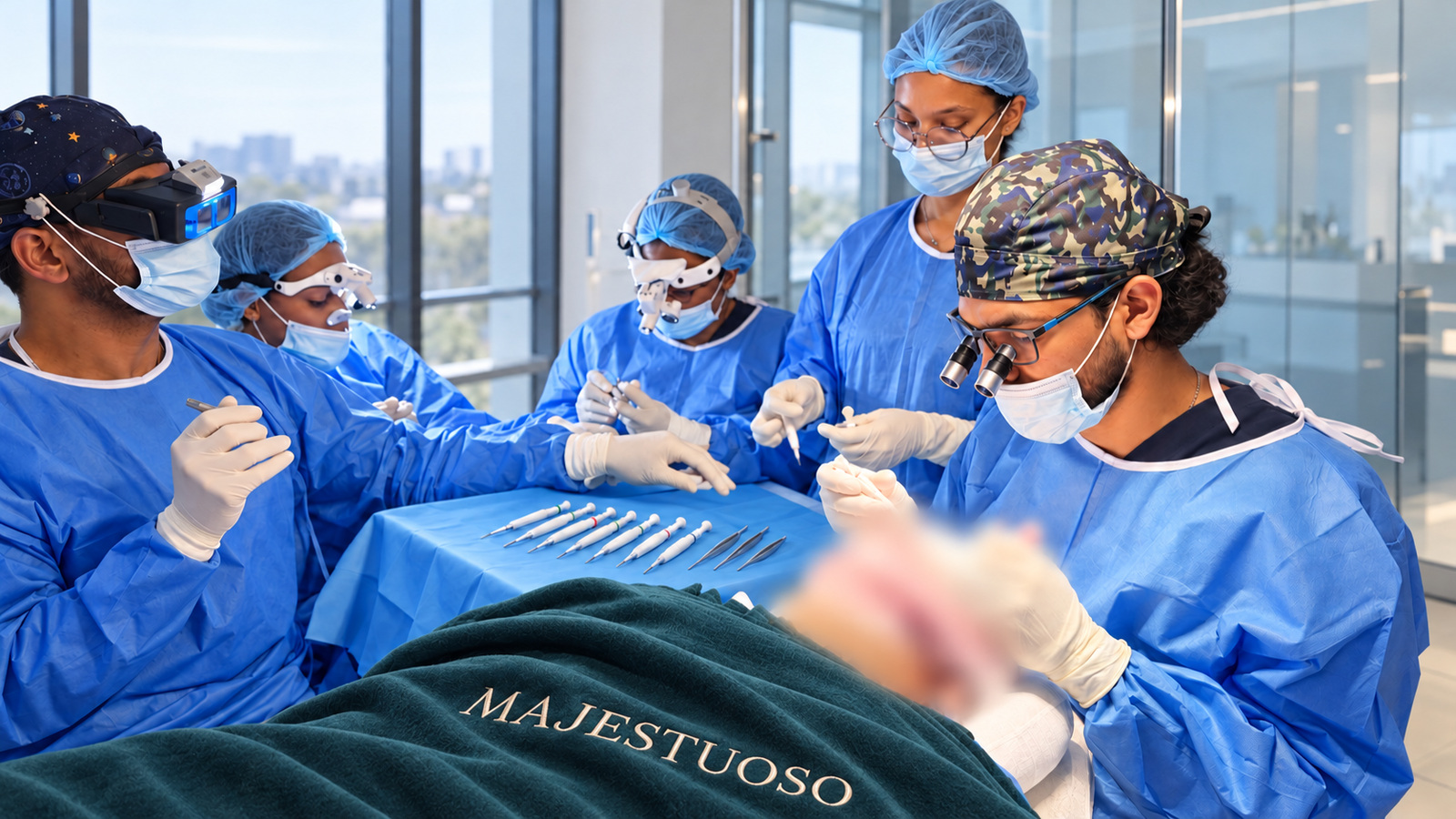
The process generally includes reviewing the plan, documentation photographs, design, donor preparation, local anaesthesia, harvesting, graft preservation and implantation. Duration depends on graft numbers, areas and individual characteristics; the clinic’s educational material commonly describes a day of around 6–8 hours, without guaranteeing a fixed duration.
Confirm arrival time and eating or fasting instructions directly with the team. Wear the recommended clothing and arrange your return according to your instructions. Before leaving, you should understand aftercare, contact arrangements and planned reviews.
Does a hair transplant hurt, and what anaesthesia is used?
Transplantation is commonly performed with local anaesthesia to control discomfort in the treated areas. Its administration may be uncomfortable, and experiences differ. An entirely painless procedure or an identical anaesthetic plan for every patient should not be promised.
Discuss allergies, previous reactions, anxiety and current medication at consultation. Ask which professionals will take part, what arrangements apply to you and what discomfort may occur afterwards. Medication and recovery instructions should be individual, with a way to report unexpected symptoms.
Do I have to shave my head for a hair transplant?
Trimming or shaving depends on donor characteristics, procedure extent, technique and the intended workflow. Different degrees of trimming are possible, but they are not suitable for every patient or equivalent in all circumstances.
Explain early if keeping your length or maintaining discretion for work is important. The team should clarify what is feasible before you decide. Avoid booking solely on the promise of an unshaven procedure: donor planning and follow-up remain important parts of the discussion.
Why discuss tobacco, alcohol and supplements before surgery?
These habits and products belong in your preoperative history alongside medication and health conditions. Explaining how much and how often you use them helps the team organise preparation and clarify restrictions for your procedure and recovery.
Do not use someone else’s timeline as permission to smoke, drink or restart a supplement. Majestuoso Clinic should provide individual instructions and answer questions before the planned date. If a recommendation is difficult to follow, discuss it early so the plan can be reviewed rather than concealing it or changing instructions independently.
Recovery and results
What should I expect in the first weeks after transplantation?
Tenderness, redness, small scabs and swelling may occur during early recovery. Progress varies, and donor and recipient areas need specific care. Do not pick scabs or manipulate grafts based on advice outside your own plan.
Majestuoso Clinic will explain washing and review arrangements for your procedure. Plan rest, work and activities in advance. If something differs from the instructions you received, contact the team before changing products or care independently. A progress photograph may help communication but cannot always replace an examination.
Is early shedding of transplanted hair normal?
Some visible transplanted hair shafts may shed in the first weeks before a new growth phase. This initial shedding alone does not establish that the follicles were lost or that the procedure failed. Progress is interpreted over time and at follow-up.
Keep photographs taken under similar conditions and discuss concerns with the clinic. Not every change has the same explanation. If unexpected symptoms or deterioration occur, request assessment; do not start medication or treatment simply because another patient’s timeline looks different.
When will I see hair transplant results?
Change is gradual rather than immediate. Majestuoso’s educational material describes the early months as an adaptation and growth period, with reviews during the first year. Texture, treated area, length and styling influence the visible impression of progress.
An early photograph should not be treated as a final result. Assessment of maturation may extend beyond the first year in some cases. Agreeing on follow-up helps compare stages sensibly and address questions about the crown, hairline or donor area without expecting one identical timeline for everyone.
When can I exercise, visit the beach or return to work?
Return depends on exertion, sun exposure, helmet use and recovery. Desk work differs from heavy lifting, contact sports or outdoor work. Discuss beaches, pools, saunas and intense sweating before the procedure.
Request written instructions and individual clearance for each activity. If travelling to the Dominican Republic, separate surgical planning from sightseeing: do not book beach trips immediately afterwards on the assumption they will be allowed. Feeling comfortable early does not mean grafts can tolerate unrestricted friction or exposure.
What risks should I discuss, and when should I contact the clinic?
Hair transplantation carries surgical risks, including bleeding, infection, scarring, medication reactions and growth or appearance that falls short of expectations. History-taking and informed consent are part of deciding.
Contact the team for severe or increasing pain, fever, discharge, persistent bleeding or a concerning change. A paid priority consultation is not an emergency service. For breathing difficulty, chest pain or another severe symptom, seek local emergency care rather than waiting for a form or WhatsApp response.
Further reading: American Society of Plastic Surgeons · Hair transplant risks and safety ↗Will the result last forever, and might I need a second transplant?
Transplanted follicles retain characteristics of their origin, but lifelong density or survival cannot be guaranteed for everyone. Native hair elsewhere may continue to thin, and donor resources remain limited. Planning should therefore look beyond the first session.
Some patients are assessed for another procedure to address a new area or improve coverage. This decision follows assessment of progress, maturation and scalp condition. There is no automatic date or assured second operation: discuss achievable goals and how remaining donor resources will be protected.
Beard transplantation
What is a beard or moustache transplant?
A beard transplant may add hair to areas of sparse facial coverage when assessment of the skin, cause of loss and donor supply supports it. Planning may address cheeks, jawline or moustache according to your goals and what is feasible.
It involves more than filling gaps: direction, blending with existing facial hair and donor texture matter. For a beard transplant consultation in the Dominican Republic, share clear photographs and describe your usual style. A proposal and quotation require individual assessment rather than copying someone else’s design.
Where does beard donor hair come from, and how is texture selected?
The back of the scalp may be assessed as a source of follicular units for beard restoration. The clinician compares calibre, curvature and colour with existing facial hair; donor hairs do not all produce the same appearance in a different area.
Coily, curly, wavy or straight texture should be part of the design discussion. Goals depend on facial features and actual supply, with an explanation of maintenance and limitations. Choosing a particular implantation device cannot guarantee a beard identical to a reference photograph.
How are beard results assessed, and what follow-up is needed?
Beard restoration involves an initial recovery period followed by growth assessed through photographs and reviews. Appearance in the first days does not show final density; growth, length and grooming change what is visible.
Ask how to care for the skin, when to resume shaving and which reviews are planned for you. Scalp-transplant instructions cannot simply be applied unchanged to the face. If you live outside the Dominican Republic, agree before travelling how progress will be communicated and where to seek care if an in-person assessment becomes necessary.
Eyebrow transplantation
Who can consider an eyebrow transplant?
Someone with sparse or partially missing eyebrows can request assessment of the cause, skin and feasibility of transplantation. Gaps do not all have the same cause, and some conditions require medical care before surgical restoration is considered.
Eyebrow consultation covers shape, symmetry and expectations while recognising that faces are not perfectly symmetrical. Reference photographs may help explain your goals, but design must suit your anatomy and donor hair. Initial photo-based guidance alone does not confirm candidacy.
How is a natural-looking eyebrow design planned?
Eyebrow planning involves suitable donor hair, direction, angle and transitions. The inner brow, body and tail do not share exactly the same growth direction, so design and placement require detailed assessment.
Scarring and previous cosmetic procedures also matter. Mention micropigmentation or previous shape changes so they can be considered together. Transplantation adds hair, whereas other techniques change the appearance of the skin; they are not interchangeable and do not produce the same type of result.
Does transplanted eyebrow hair need trimming and maintenance?
Hair moved from the scalp retains characteristics of its origin and may need trimming and grooming to maintain the eyebrow shape. It should not be promised to automatically adopt the original eyebrow growth pattern or become maintenance-free.
Before eyebrow transplantation, discuss the upkeep you are willing to do and the available texture. The team will explain when to begin according to healing. Frequency varies with actual growth. An informed decision covers both surgery and the ongoing routine that may accompany the result.
Guidance and medical consultations
What if I want to address hair loss without having a transplant?
You can request a medical consultation for that purpose. Trichology includes assessment of loss and options for caring for existing hair. Not everyone contacting Majestuoso Clinic needs a transplant, and surgery is not the answer to every reduction in density.
Treatments depend on diagnosis, medical history, contraindications and expected response. Do not start medication from an FAQ list or assume one treatment can cure every form of alopecia. Explain whether your priority is slowing progression, improving appearance or deciding whether to wait before considering surgery.
Can I request assessment if I have diabetes, hypertension or another medical condition?
You can request information and assessment; that is not automatic clearance for surgery. Chronic conditions, medication and history may alter planning or require postponement. Health control and coordination with your treating clinicians are part of assessment.
Share relevant information, including allergies, surgery and healing problems. Do not stop treatment independently to try to meet a requirement. Decisions about scalp, beard or eyebrow transplantation must be individual, explaining whether surgery is appropriate, what limitations apply or what needs attention first.
What does Majestuoso Clinic’s free hair guidance include?
Your Starting Point is free, personalised remote guidance delivered in writing. An advisor reviews your form, goals and three photographs to prepare a PDF with your name, photos, observations and next steps. It explains points to discuss with a doctor, donor-area considerations and questions about safety and who is responsible for the procedure.
It does not include medical assessment, diagnosis, confirmation of candidacy or a procedure quote. Once your request is saved, the website displays a reference. You may optionally continue on WhatsApp with your details, answers and a case link reserved for authorised staff; the request remains in the inbox even if you do not use WhatsApp. The advisor prepares and reviews the PDF in the private inbox and attaches it when replying; it is not automatically generated or sent without review.
How do online, in-person and priority consultations differ?
The online medical consultation costs US$60, with an indicative 3–4 week wait. The in-person consultation also costs US$60, with an indicative 3–4 week wait. Regular requests are arranged on Mondays, 10 a.m.–6 p.m. Dominican Republic time, subject to availability.
The priority medical consultation costs US$150 and may be online or in person, targeting 24–48 hours subject to availability and final confirmation. Payment confirms the appointment after availability is agreed. These fees cover consultation, not transplantation. Priority consultation is not an emergency service.
How do minoxidil, finasteride and platelet-rich plasma fit into hair-loss care?
These terms commonly appear in hair-loss research, but they do not describe the same intervention or suit every diagnosis. A medical consultation can explain which options are relevant to your condition, their limitations and the follow-up they require.
Popularity or a promotional package should not determine treatment. Report any minoxidil, finasteride, supplements or other products you already use and your response. Do not start, combine or stop treatment based on this page. Written advisor guidance helps organise information; medication and procedure recommendations belong to a medical professional.
How should I take the guidance photos, and who can see them?
The form requests three views: front and temples, top and crown, and the back or donor area. Use adequate light, focus on the scalp and avoid filters, documents or other people. The form’s 3D examples illustrate positions; they are not patient photographs.
All three images are required to submit. If you cannot take them now, save a private draft and return using your link. Submitted photos are stored for the authorised team and do not enter the public gallery. The WhatsApp summary states that you attached them without including private image links.
Why is a medical consultation important?
A hair transplant consultation is time to understand the cause of hair loss, discuss alternatives and assess whether a procedure makes sense for you. The aim is an informed decision with clear expectations and limitations.
01 · Understand the cause, not just the area A receding hairline, thinning crown or reduced density can have different causes. A doctor reviews your history, scalp and health background and may recommend investigations. Photos help prepare the conversation but cannot replace every examination that may be needed.
02 · Protect a limited donor supply A transplant redistributes hair; it does not create new follicles. Assessing the donor area, hair calibre, texture and possible future loss supports realistic coverage planning. Graft numbers, design and surgical suitability require an individual medical assessment.
03 · Consider timing and alternatives Some patients need the cause of hair loss or a scalp condition assessed or treated before surgery; others may discuss a transplant. Hair loss does not always require surgery. An advisor cannot confirm candidacy or prescribe treatment; written guidance helps you prepare for the right medical discussion.
04 · Know who is responsible for your care Ask for the responsible doctor's name and licence, their involvement in surgical steps, the team's roles and the facility's authorisation. Hair transplant black-market practices can involve inadequate medical involvement or unlicensed personnel. Checking credentials and responsibility supports informed choices.
05 · Discuss risks and follow-up Possible complications include infection, bleeding, unfavourable scarring, altered sensation, insufficient growth or donor-area damage. Your doctor explains your individual risks, alternatives and aftercare. Ask how follow-up works and whom you should contact if a problem occurs.
06 · Understand what the fee covers At Majestuoso, the medical consultation fee covers professional assessment time, review of your situation and a discussion of options and next steps. A free or paid consultation alone does not establish quality. Compare scope, credentials and follow-up alongside price. The consultation fee does not include a procedure.
Free guidance in a PDF prepared for you An advisor reviews your form and three photographs to prepare a PDF with your name, the information you shared and points to discuss before deciding. It includes a suggested focus for your next conversation and a practical decision guide. It is not a diagnosis, confirmation of candidacy or a procedure quote.
Further reading: American Academy of Dermatology · Hair loss diagnosis and treatment ↗Further reading: American Society of Plastic Surgeons · Hair transplant risks and safety ↗Further reading: ISHRS · Patient safety and physician involvement ↗Further reading: ISHRS · Hair transplant black-market red flags ↗Costs, locations and travel
How much does scalp, beard or eyebrow transplantation cost in the Dominican Republic?
Procedure cost depends on assessment, treated area, donor supply, complexity and the confirmed plan’s inclusions. Texture and previous procedures also affect planning. A budget range entered in the form is not the clinic’s final price.
Request a proposal explaining the procedure, follow-up, payment terms and included or separate items. If travelling, distinguish clinical fees from transport and accommodation. Free guidance does not provide a procedure quotation; medical consultations have their own fees, which are not the cost of surgery.
Where can I consult Majestuoso Clinic in Santo Domingo or Santiago?
The Santo Domingo reference address is Calle Ramón Santana No. 27, Distrito Nacional, Dominican Republic. You may also request a Santiago consultation by appointment. For Santiago, the team confirms the location directly when coordinating; an address that has not yet been defined is not published.
Evaluation buttons and the website contact number lead to the intake journey and care options. State your preferred city. A requested date is not an automatic reservation: await confirmation of availability, format, location and payment when applicable before arranging your visit.
How can I plan a consultation from the United States, Canada or the Caribbean?
Start from home using the website journey and choose written guidance or an online medical consultation. Explain your country of residence, tentative dates and whether you prefer Spanish, English or French. This helps clarify missing information before planning travel to the Dominican Republic.
Before purchasing flights from the United States, Canada, Puerto Rico or another Caribbean island, confirm assessment, location, reviews and the stay recommended for your case. Flights, hotels and transfers are not automatically included. Agreeing on communication after returning home is also an important part of planning.
How should I compare hair transplant clinics and before-and-after cases?
Compare diagnostic clarity, the responsible professionals, donor conservation, explained expectations and follow-up. Price or a promise of many grafts alone cannot establish which proposal suits you. Ask what limitations and risks have been identified for your case.
Majestuoso Clinic’s gallery includes different textures and areas. Review the full before image, full after image and follow-up time; lighting, styling and angles may differ. Google reviews describe personal experiences, and a published result does not guarantee yours. Use those references to prepare an informed conversation.
References and editorial approach
Adapted from the clinic’s educational and preparation materials. General concepts were checked against the independent references below. Aftercare, medication and surgical suitability are individualised at consultation.
Ready to discuss your situation?
Start with three simple questions, then choose free written guidance or a medical consultation.
Choose my consultation ↗Explore the tools →